
Amazon Clone App Development
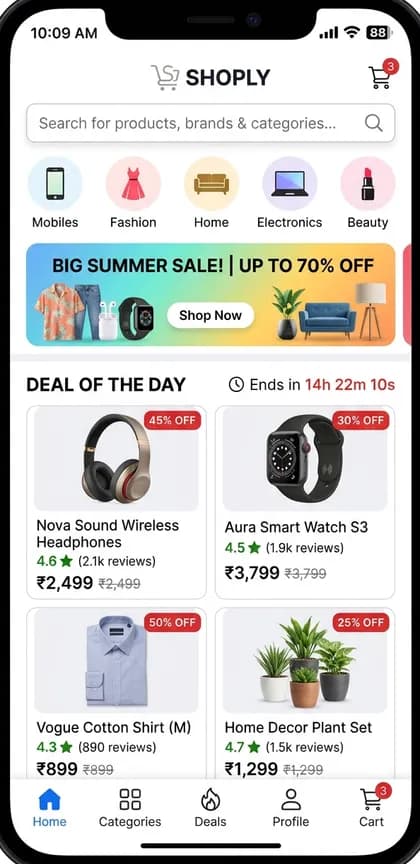
An Amazon-style app is a large multi-vendor marketplace with broad categories, strong search, seller tools and dependable fulfilment. For most businesses the opportunity is a focused version of this model — a region, a category or a B2B niche — rather than a copy of everything.
It is inspired by the publicly known Amazon business model, but it is not affiliated with, endorsed by or a copy of Amazon. CloneAppTech designs and builds original apps, dashboards and integrations around your brand, pricing and operating rules.

Business model
How a Amazon-style app makes money
Revenue comes from seller commissions, fulfilment and shipping fees, sponsored product placements and memberships. Seller success tools directly affect marketplace growth.
Multi-vendor marketplace
Sellers list products; you earn commission and listing or advertising fees.
D2C / single brand
Your own catalogue with higher margins and direct customer data.
Social and reseller commerce
Resellers or creators share products and earn margins or commission.
Target audience & use cases
Who this solution is for
- Regional marketplace founders
- Category specialists (electronics, home, industrial)
- Retail groups opening their platform to third-party sellers
Core application features
What the product needs on day one
- Catalogue with variants and filters
- Cart, coupons and checkout
- Order tracking and returns
- Personalised recommendations
- Faceted search
- Variant and SKU management
- Shipping aggregator integration
- Return and refund workflow
- Seller settlements
- Recommendation widgets
Apps & user roles
Features for every role involved
Only the roles that apply to this business model are included.
01
Shopper app
- Search with filters and sorting
- Product variants and reviews
- Wishlist, cart and saved addresses
- Order tracking and returns
02
Seller panel
- Catalogue and inventory management
- Order processing and shipping labels
- Payouts and performance metrics
03
Admin panel
- Seller approval and commission
- Category and attribute management
- Promotions, banners and coupons
- Returns and dispute handling
Workflow
How a typical storefront flow runs
- 1
Shopper searches and compares products
- 2
Cart is checked out with chosen payment method
- 3
Seller or warehouse packs the order
- 4
Shipping partner picks up and tracking updates flow back
- 5
Delivery, returns window and seller payout follow
Technology & integrations
Technical considerations
- Search quality and image performance have the largest impact on conversion.
- Search quality drives revenue; consider a dedicated search engine for large catalogues.
- Shipping and tax rules differ by region and should be configurable.
- Image optimisation and caching for fast product pages.
- Payment gateway choice affects settlement times for sellers.
Customisation options
Make it yours
- Your brand identity, colours, typography and app icon
- Business rules for storefront configurable from the admin panel
- Languages, currencies and regional tax settings
- Payment gateways and payout methods available in your country
- Commission, fee or subscription structure
- Optional modules added in later phases
Development scope
A typical first release includes the shopper app, seller panel, admin panel, a backend API, cloud hosting setup and the integrations for storefront. Optional modules are planned into later phases.
Factors affecting pricing
What drives the cost of a Amazon-style app
Medium-level projects typically start from ₹1.5 Lakh ($1,800). Your exact quote depends on these factors.
- Catalogue, search and checkout
- Catalogue size and attribute complexity
- Single vs. multi-vendor
- Shipping and ERP integrations
- Live or social commerce features
- Cross-border currencies and duties
Project phases
Estimated phases, testing and launch
Durations are agreed after discovery; testing, deployment and maintenance are part of every plan.
Phase 1
Discovery
Confirm the Amazon-style app business model, user roles and must-have features.
Phase 2
Design
Original user flows and interface design for each app and the admin panel.
Phase 3
Build
Mobile apps, backend APIs and storefront.
Phase 4
Test
Functional, device and load testing of critical flows.
Phase 5
Launch
Store submission, cloud deployment and monitoring.
Phase 6
Improve
Maintenance and roadmap features based on real usage.
FAQs
Amazon Clone App questions
Do I need my own warehouse?+
No. Sellers can ship directly, and platform-run fulfilment can be added later.
How much does it cost to build a Amazon-style app?+
Cost depends on the roles you need (shopper app, seller panel, admin panel), the depth of storefront, integrations and platforms. Medium-level builds typically range from ₹4–10 Lakh ($4,800–$12,000) for multi-role apps, and from ₹1.5 Lakh ($1,800) for a focused first release; we confirm the exact quote after reviewing your requirements.
Can the app sync with my inventory?+
Yes, through your POS, ERP or e-commerce platform's API.
Is this an official Amazon product?+
No. CloneAppTech is an independent development company. Amazon is referenced only to describe a business model; all trademarks belong to their owners.
Can sellers manage their own shipping?+
Yes. You can allow self-shipping, platform-managed shipping, or both per seller.
Related
Explore related solutions
Related app models
Related categories
Development services
Next steps
Free consultation
Planning a Amazon-style app?
Tell us your market and must-have features. We'll suggest a realistic first release for your amazon clone app and the next steps.