
Uber Clone App Development
An Uber-style app is a two-sided mobility marketplace: riders request trips, independent drivers accept them, and the platform sets fares, manages safety and settles payments. Beyond the familiar map screen, the real work is in dispatch rules, fare configuration, driver onboarding and support tooling.
It is inspired by the publicly known Uber business model, but it is not affiliated with, endorsed by or a copy of Uber. CloneAppTech designs and builds original apps, dashboards and integrations around your brand, pricing and operating rules.
Business model
How a Uber-style app makes money
The platform usually keeps a commission on each fare, with optional booking fees, surge multipliers and premium vehicle classes. Some markets favour driver subscriptions instead of commission; the system can support either.
Commission-based marketplace
Independent drivers keep most of the fare; the platform takes a percentage per trip.
Subscription for drivers
Drivers pay a fixed daily or monthly fee instead of per-ride commission.
Fleet or corporate operator
You own or lease vehicles and serve businesses or airport routes on contract.
Target audience & use cases
Who this solution is for
- Taxi operators modernising their fleets
- Mobility start-ups launching in a new city
- Corporate transport providers
Core application features
What the product needs on day one
- Real-time slot availability
- Buffer times and capacity limits
- Reminders by push, SMS or WhatsApp
- Reschedule and cancellation policies
- Live map tracking with ETA
- Geofenced arrival and departure events
- Route history and playback
- Shareable tracking links
- Real-time GPS tracking
- Fare engine with base, distance, time and surge
- Driver verification
- In-app calling with number masking
Apps & user roles
Features for every role involved
Only the roles that apply to this business model are included.
01
Rider app
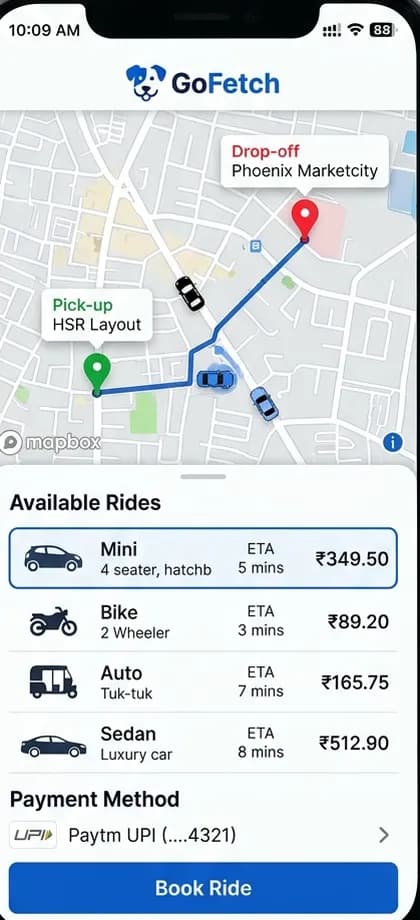
- Pickup/drop search and fare estimate
- Vehicle type selection
- Live driver tracking and ETA
- Cash, card, wallet or UPI payments
- SOS and trip sharing
02
Driver app
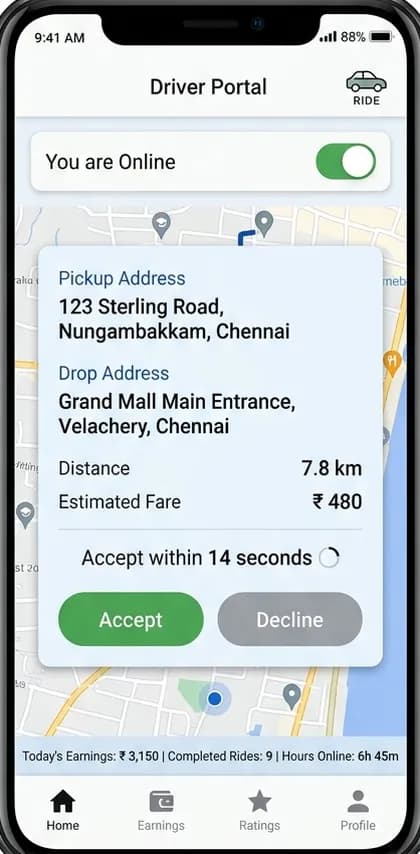
- Online/offline toggle and ride requests
- Turn-by-turn navigation
- Earnings, incentives and payouts
- Document upload for verification
03
Admin panel
- Driver onboarding and KYC review
- Fare rules, surge and zones
- Trip monitoring and disputes
- Promotions and referral programs
Workflow
How a typical scheduling engine flow runs
- 1
Rider sets pickup and destination and sees a fare estimate
- 2
Dispatch sends the request to nearby eligible drivers
- 3
Driver accepts, navigates to pickup and verifies the rider by OTP
- 4
Trip runs with live tracking and the fare is finalised
- 5
Payment settles and both sides rate each other
Technology & integrations
Technical considerations
- Calendar sync with Google or Outlook and time-zone handling prevent double bookings for multi-location businesses.
- Frequent location updates require efficient background tracking and a real-time channel; map API usage is a recurring cost tied to volume.
- Location updates every few seconds require an efficient socket or MQTT layer.
- Map, routing and geocoding APIs are a recurring cost that scales with trips.
- Background location handling differs between Android and iOS.
- Dispatch logic should be configurable without new app releases.
Compliance note: Passenger transport is licensed in most jurisdictions. Plan driver background checks, insurance, data retention and local aggregator rules before launch.
Customisation options
Make it yours
- Your brand identity, colours, typography and app icon
- Business rules for scheduling engine configurable from the admin panel
- Languages, currencies and regional tax settings
- Payment gateways and payout methods available in your country
- Commission, fee or subscription structure
- Optional modules added in later phases
Development scope
A typical first release includes the rider app, driver app, admin panel, a backend API, cloud hosting setup and the integrations for scheduling engine and live location. Optional modules are planned into later phases.
Factors affecting pricing
What drives the cost of a Uber-style app
Medium-level projects typically start from ₹1.5 Lakh ($1,800). Your exact quote depends on these factors.
- Slot engine and reminders
- Maps, routing and real-time updates
- Number of vehicle types and services
- Dispatch sophistication (nearest vs. scored matching)
- Maps and SMS usage volume
- Payment and payout integrations
- Corporate or rental modules
Project phases
Estimated phases, testing and launch
Durations are agreed after discovery; testing, deployment and maintenance are part of every plan.
Phase 1
Discovery
Confirm the Uber-style app business model, user roles and must-have features.
Phase 2
Design
Original user flows and interface design for each app and the admin panel.
Phase 3
Build
Mobile apps, backend APIs and scheduling engine, live location.
Phase 4
Test
Functional, device and load testing of critical flows.
Phase 5
Launch
Store submission, cloud deployment and monitoring.
Phase 6
Improve
Maintenance and roadmap features based on real usage.
FAQs
Uber Clone App questions
Can it support rentals and outstation trips?+
Yes. Hourly rentals and intercity trips are additional ride types with their own fare rules and driver eligibility.
How much does it cost to build a Uber-style app?+
Cost depends on the roles you need (rider app, driver app, admin panel), the depth of scheduling engine, integrations and platforms. Medium-level builds typically range from ₹4–10 Lakh ($4,800–$12,000) for multi-role apps, and from ₹1.5 Lakh ($1,800) for a focused first release; we confirm the exact quote after reviewing your requirements.
Can I reduce no-shows?+
Automated reminders, deposits and cancellation windows are the most effective combination.
Does live tracking drain the phone battery?+
It can if done poorly. Adaptive update intervals and platform-native background modes keep battery use reasonable.
Is this an official Uber product?+
No. CloneAppTech is an independent development company. Uber is referenced only to describe a business model; all trademarks belong to their owners.
How is surge pricing decided?+
It is a rule you control — usually a multiplier triggered by demand-to-supply ratio in a zone, with caps you define.
Related
Explore related solutions
Related app models
Related categories
Development services
Next steps
Free consultation
Planning a Uber-style app?
Tell us your market and must-have features. We'll suggest a realistic first release for your uber clone app and the next steps.